

Diverging population trends in Brünnich’s guillemots on Svalbard linked to wintering strategies
A new study sheds light on how variations in migration strategy may underlie contrasting population trends of Brünnich’s guillemots (Uria lomvia) across Svalbard. While populations in the west and south of the archipelago are declining, northeastern colonies appear to be stable or even increasing. The explanation seems to lie in their choice of different wintering areas.
Diverging trajectories within a rapidly warming region
Long-term monitoring has documented sustained declines in Brünnich’s guillemot colonies in western and southern Svalbard, consistent with patterns seen across much of the Atlantic sector of the Arctic. These declines have been linked to reduced recruitment and adult survival rates, likely associated with deteriorating wintering conditions and changes in prey availability.
In contrast, a large colony in northeast Svalbard is increasing in numbers. This difference is particularly striking given the relative geographic proximity of the colonies in question, and it raises important questions about how non-breeding season ecology may mediate population trajectories.
Migration strategy as a key mechanism
Using tracking data, the study identified a clear difference in overwintering behaviour between colonies: Birds from western and southern colonies predominantly migrated to more temperate regions — including areas between Iceland and southern Greenland, and parts of eastern Canada. In contrast, birds from northeastern Svalbard remained largely in the northern Barents Sea, wintering in high-Arctic waters.
The authors argue that this spatial segregation during the non-breeding season may go a long way to explain the different population trends. The northern Barents Sea, although undergoing rapid climate change, may still offer favourable foraging conditions in winter compared to the increasingly variable and possibly resource-poor west Atlantic wintering grounds.
Implications for arctic seabird conservation and monitoring
This study emphasises the importance of colony-specific migration ecology on population dynamics — a finding that has broad implications for the conservation and management of arctic seabirds. First, local variations in both migration strategy and demographic trends highlight the need for multi-colony monitoring even at a regional scale. In addition, the findings reinforce the importance of the non-breeding season in shaping population-level outcomes, emphasizing that year-round tracking is essential to understanding seabird responses to environmental change.
Read the article:

Photo © Sébastien Descamps, Norwegian Polar Institute
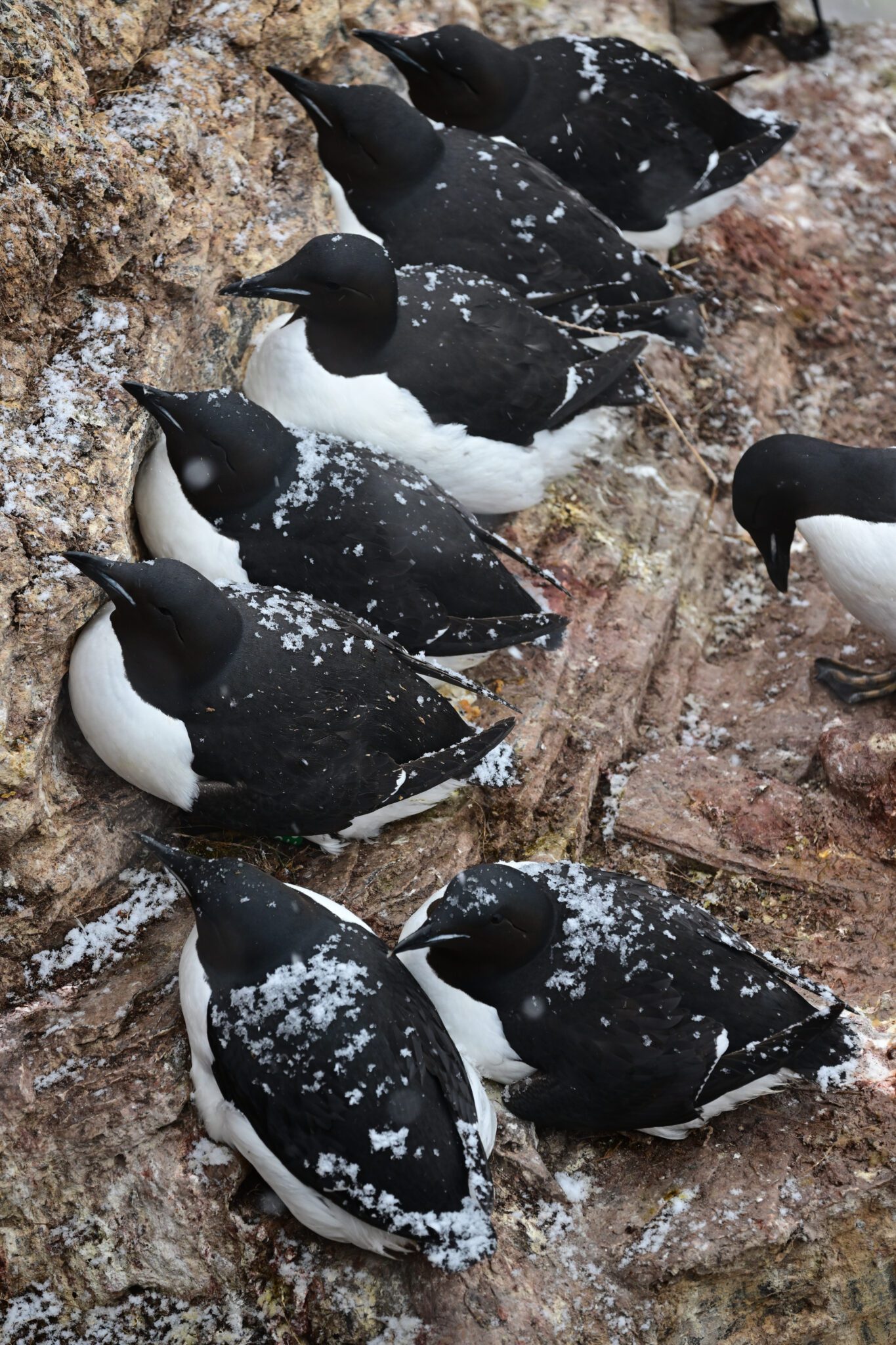
Photo © Sébastien Descamps, Norwegian Polar Institute
Contact person: Sébastien Descamps, Norwegian Polar Institute