

Newly-developed attachment method for bird loggers
Researchers have developed an innovative, non-permanent attachment method for bird-borne tracking devices using 3D-printed clamps and glue. Tested across six seabird species in Norway, GPS devices remained attached for weeks to months, providing valuable data while apparently inflicting very little stress or harm to the birds.
Need for alternative to permanent harnesses
Short-term tracking of birds often involves glue or tape attachments, which frequently detach prematurely, leading to data loss and potential harm to the birds. Alternative permanent harness attachments can affect flight, reproduction, or survival rates. To address this, a research team led by Sindre Molværsmyr and colleagues developed a novel, non-invasive method using 3D-printed clamps designed to hold small solar-powered GPS devices and securely fasten to feathers with a minimal amount of glue.
Tested seven variants
Between 2023 and 2024, 86 GPS units were deployed on six seabird species across seven sites in Norway. They used seven variants of 3D-printed clamps, made from PETG, weighing between 0.5 and 3.2 g, which is well below recommended attachment limits.
–The clamps were designed for either mantle or tail feathers, interlocking with the device and sandwiching feather shafts, Sindre Molværsmyr explains.
A small amount of cyanoacrylate glue (Loctite 4070) was used to secure the attachment. The clamps were produced with standard 3D printers, optimized for solar panel exposure and readily adjustable before final fixation.
High success rate
The novel clamp method proved highly effective. For mantle feathers (77 birds), devices remained attached for an average of 39 days; for tail feathers (4 birds), the average was 77 days. The system achieved a 94 % return rate from 86 deployments, with only minimal material costs and apparent low bird inconvenience in comparison with other known methods. These time spans enabled monitoring of critical life stages like incubation and chick rearing.
Suitable for short and mid-term studies
The conclusion of the study is that the 3D-printed clamp-based attachment are a low-cost, customizable, and animal-friendly alternative to traditional tape and harness-based methods.
– In addition to an apparent low impact on the birds, our method offers improved data collection through longer attachment times and optimal solar panel exposure, says Molværsmyr.
Moreover, the authors emphasize that the clamp represents a lightweight, non-permanent attachment method with a reusable design that can be adapted to different species and situations.
– The advantages of this clamp-based attachment make it especially suited for short-to-mid-term ecological studies focusing on foraging behaviour, moult timing and seasonal movements, Molværsmyr concludes.
By combining practical design with conservation ethics, this study paves the way for more responsible and effective bird tracking – a step forward for movement ecology and wildlife research.
Read the article:

Photo © Erlend Lorentzen
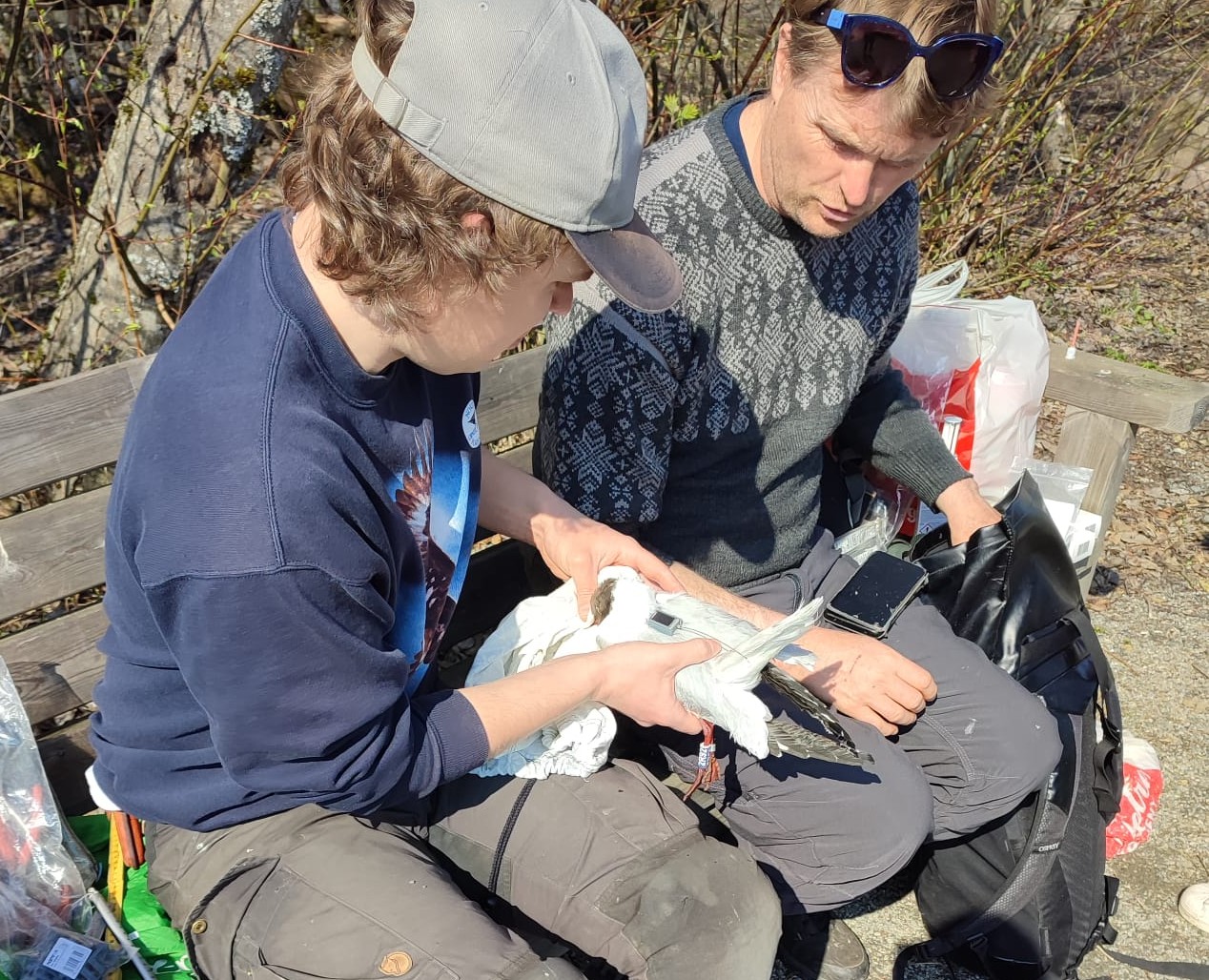
Photo © Marie Curtet
Contact person: Sindre Molværsmyr, Norwegian Institute for Nature Research